zzzzzzzHusband. Drummer. Marketing, Sales and Customer Service Specialist. Music and Art Collector. Road Cyclist. Volunteer. Traveler. bbbbbbbbbbbbbbbbbbbbbbbbbbbbbbbbbbb Amateur Photographer. Media/News/Coffee Junkie. Hockey Fan.

Tuesday, June 16, 2015

I Heart: Reflection and Respect in New York

Sandra and I have traveled to NYC every year since 2008. Even though we often find ourselves in Lower Manhattan for a walk around Battery Park (not to mention the obligatory shopping trip to retail shrine, Century 21), we have never visited the 9/11 memorial. We have our reasons, of course, and chief among them is a desire to pay our respects far away from long, snaking lineups of tourists waiting in 90F heat. We also steer clear of the even more annoying hucksters that ply the area, hawking September 11th souvenirs, like maps, T-shirts and other memorabilia. 9/11 has already been marketed to death and we see the result everyday: we have watched the creation and implementation of myriad new security systems, institutions and practices; we are forced to adhere to stupid rules and regulations in airports (as if Osama bin Laden is alive and well and hiding in our toothpaste); we are implored to 'remember' by purchasing all sorts of commemorative crap sold on television; and what's left of our privacy bends over in the name of national security. Thanks, Osama. And Rummy. And Wolfy. And that Dick Cheney. 

We remember that morning in 2001 all too well; even though we watched it unfold on TV we now have a very clear and personal appreciation of how that event forever changed our favourite city - and our friends & family who call New York home. We knew we would one day remember and reflect in our own way at Ground Zero; we simply were never in any great hurry.

As yesterday was our last day in NYC and since we happened to be in the area (Century 21...mea culpa), we decided to finally visit the Pools of Reflection. Line-ups are now a thing of the past, thankfully, as passes and security screening are no longer required. Besides, you can look down on the pools from the surrounding office buildings as well as the observation deck of the new One World Trade Center. The pools are massive square waterfalls situated on the footprints of what were the North and South towers of the WTC. The names of the dead are engraved around the perimeter of each pool. As expected, there were many visitors lost in deep and emotional reflection in the park-like setting. I found the pools to be both haunting and disturbing. If this was the intent, the designers succeeded: the water pours down from all 4 sides, then flows - or rather drains - into a large square void in the centre of each pool, falling into a black, unseen nothingness. Into forever. Gone.

Many believe that the full story of 9/11 must be viewed through the prism of US foreign policy. I tend to agree, although I also believe indoctrinated and unreasonable douche bags flying planes into the Twin Towers at the behest of other indoctrinated and unreasonable douche bags is a pretty shitty and cowardly way to make your point. It's 'dirty pool', as they say - the dirtiest, really - and many innocent people died during that game. Sorry you bozos, but you failed spectacularly (see marketing of 9/11, above). There are those as well who will point to the suffering and death that stains our world, and that 3000 lives are nothing compared to the tens of thousands who die unnecessarily every day. It's a spurious argument and insensitive in the extreme. One is too many, anywhere, in any circumstance. 

Our visit was not about politics. It was about the names engraved on the edges of the pools. Mothers, fathers, sisters, brothers; wives, partners, husbands, sons and daughters. They went to work one day and fell into a black unseen nothingness. Into forever. Gone. I hold them responsible for nothing more than being in the right place at the worst possible time. Choose: burn to death or jump to death. Hell's oceans are a contaminated slurry of confused politics and twisted ideology. 

As we wandered around the pools, checking out the very international collection of names, scattered among the reverential were groups of seemingly brainless tourists posing - yes, posing - in front of the pools like they were at the goddam Eiffel Tower or Empire State Building ('is this my good side?' No. Your good side is behind you, just below your waist). I mean, like, seriously. There they were, in what is essentially a public cemetery, getting into position and smiling for the cameras, smartphones and tablets. Imagine: the 9/11 memorial site as bucket list item to be ticked off the been-there-done-that check box. I know: Sandra and I were tourists, too, and my righteous indignation may come off as more than a little hypocritical. So be it. I took no photos and stared at the black void. 

Ok, I lied a little. I did take a number of photos but the only images I shot were of the gleaming new One World Trade Center standing tall, or, as a good friend remarked today, raised like a giant middle finger with a message to those that would see it, too, knocked down. I never saw the original Twin Towers in person; like many millions, I only saw them fall. The images I took today are my way of celebrating fresh, powerful and iconic architecture, while keeping alive the spirit of the original towers - and the people who worked and died there.


Wednesday, April 8, 2015

Frite To Be Tried: My Belgian Spin

My last few hours of 2+ weeks in Belgium. This has definitely been a trip to remember, full of terrific memories and unique experiences that I will savour for quite some time.


The Belgians are great hosts. It's not that they go out of their way to provide a warm welcome or great customer service. It is simply the way things are done; there is no 'phoning it in' over here. Not doing great work is simply unthinkable. That alone, I think, is what will resonate longest: the lack of pretence and a profound lack of attitude (OK, I came across a couple of D.B.'s and was snubbed by the greatest cyclist in history, Eddy Merckx - he can be rather cantankerous - but really that was it). Most interestingly, the concepts of 'who you are' or what one's 'status' is comes across as quite insignificant. "What do you do?", often one of the first questions asked upon being introduced back home, may come up in conversation here but much, much later. It's considered a rude lead off, actually. Better evaluations by local standards (or by any standard, in my view): Are you a good person? Respectful? Do good work no matter what that work is? From my experience anyway, these are paramount attributes in Belgium. It certainly shows in the treatment of guests, clients and the way Belgians interact with friends and family, and it is on display on roads and highways. Think of that, Vancouver: a country full of keen and courteous motorists. 


I covered Belgium's rich cycling tradition here the other day so at the risk of repeating myself all I'll say is this: cycling is to Belgium what hockey is at home. In fact, I would suggest it is even more tightly woven into the collective fabric. Even though most Canadians tune in and watch hockey, not many actually play either casually or as part of league. And you certainly don't see many seniors out there back-checking. 

Oh, yes...there's the beer. I've never been much for beer, preferring stiff drinks made with bourbon, scotch, rye, vodka...you get the idea. During my time here, however, I have not had a single cocktail, nor have they been missed. Triple Karmeliet is my new favourite drink, all 8.6% of it, a beer introduced to me by a helpful waiter in Oudenaarde. All hail to the monks that indulged in developing this other (more interesting and fun?) faith.

Of course, many of my observations are not unique to Belgium or Belgians. Over the last 16 days, however, I have taken keen notice of what I have experienced and it really has been very impressive - and humbling. I have witnessed and learned much (I hope) and intend to bring some of this exceptional hospitality and thoughtfulness home with me. I owe that to everyone who made this trip so extraordinary.

Saturday, April 4, 2015

Hubs and Spokes

Ever since my first trip overseas in late 1989, I have always loved travelling in Europe. I am enthralled by the architecture, the art, the countrysides, the myriad cultural complexities within such tight geography. Since I am a road cycling enthusiast, Europe has held another fascination for me: the world of professional cycling.

For many North Americans, it was a certain Texan with huge talent, a Lone-Star sized ego, and a large dose of performance-enhancing mean-spiritedness who brought road cycling into their world. Still, it was Europe where Lance Armstrong (and American Greg Lemond back in the 1980's) really got rolling and where all pro cyclists first earn their name and reputation. It is also where the biggest stars enjoy the most fame and it has been this way since the invention of the bicycle. Nowhere is this love more intense or more obsessive than in Belgium. The Italians (pioneers in today's standard road bike technology) will protest loudly. The French will likely go on strike. Fine. Belgium has cycling woven deep into its cultural fabric, and it courses through their collective bloodstream. Nowhere is this more pronounced than in Flanders. Weekdays and weekends, in rain, mud, brutal and biting cold winds, on pavement  or on the cobbles, you see Flandrians out riding. They can be solo or on group rides with their local teammates; or, like most Belgians, just heading to work or some other destination. After all, it's only rain.


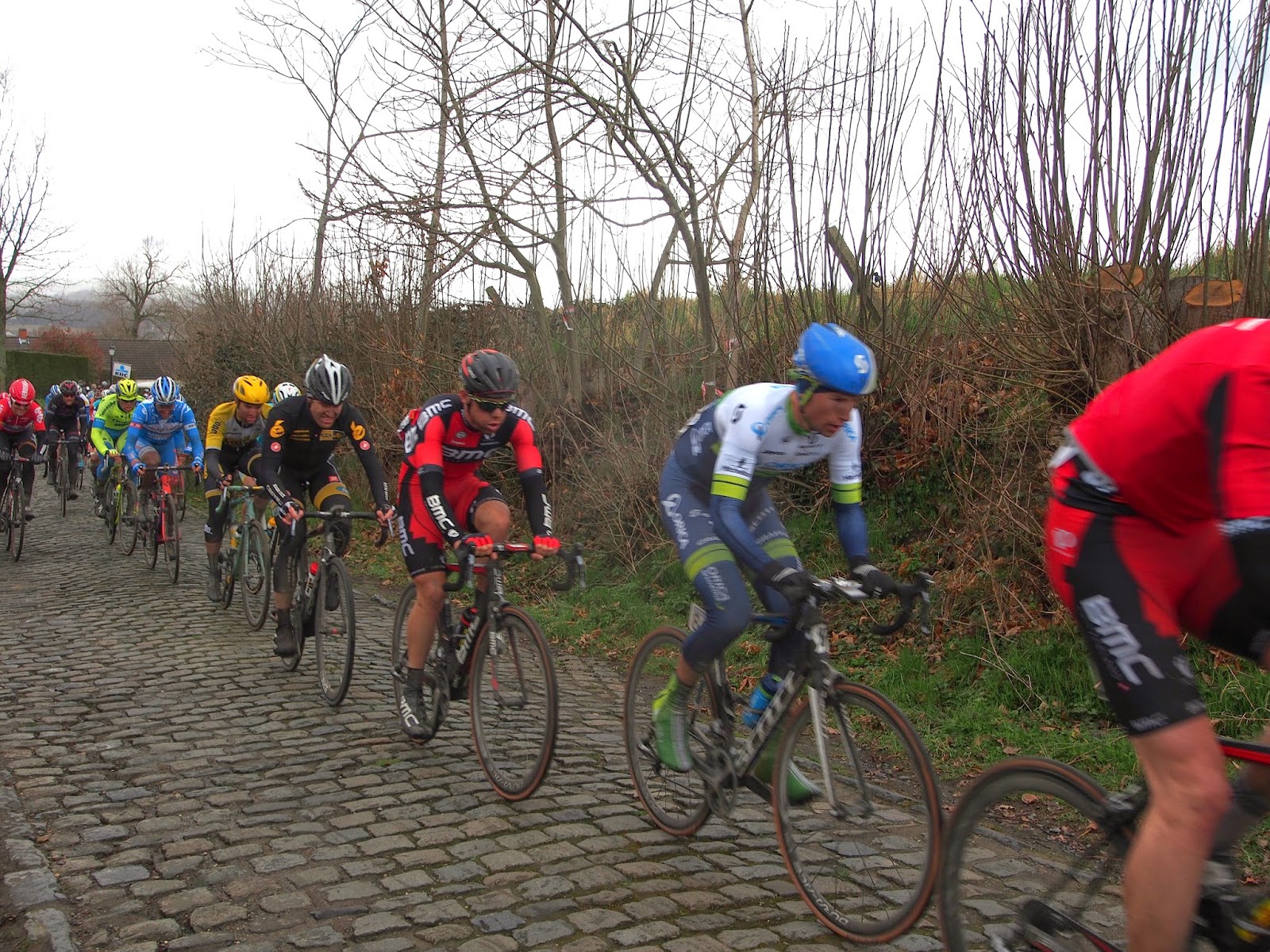
Cobblestone lanes wind lazily through the Flanders countryside connecting quaint towns and pretty villages; during a race, however, these cute paths become treacherous, often separating winners from painfully scraped and, quite often, broken competition. Many of these routes are as famous and pivotal to the sport of cycling as Wimbledon, Daytona, or the Montreal Forum (RIP) are to tennis, racing and hockey. The cobbled hills (bergs) are legendary and during Spring Classic season (March to mid April) the biggest crowds gather to cheer their heroes upward. Paddestraat (above), Oude - or old - Kwaremont (below), The Paterberg, The Kemmelberg, The Koppenberg; these scary beasts, while not nearly as long still evoke the same reverence as the high mountains of the Tour de France. Try walking up one on a rainy, muddy day and then imagine racing up 4 or more on skinny wheels, jostling for position with 150+ cyclists riding flat out at up to 45km/h for hours in the wet and wind.


The world's greatest professional cyclist by far is the Belgian legend, Eddy Merckx. He won 525 major races between this late 1960's and '70's. If you count all of Lance Armstrong's premier wins (even those recently stricken from the record), they tally below 100. In addition to his wins in all major Tours, Merckx won countless Classics titles, including the daddy of them all, the Ronde van Vlaanderen, or Tour of Flanders. More recently, Belgian heroes include Tom Boonen, who is arguably the biggest star, along with local lads Stijn Devolder, Sep Vanmarcke, Stijn Vandenbergh and others. Tom was injured in a recent crash and while I'm sorry for his injury, I'm selfishly bummed he is not racing while I'm in Belgium. Nicknamed Spartacus, another local favourite is Fabian Cancellara, a human piston. In Canadian terms, these cycling stars are Belgium's Crosby, Stamkos, Voracek, Price and Ovechkin. Cancellara is Swiss but the respect he has earned on the cobbles in East and West Flanders gives him honorary citizenship in Flanders; so large is his reputation there is actually a room (a shrine, really) dedicated to him in the Ronde Van Vlaanderen Museum in Oudenaarde. According to the proprietor of my hotel just outside town, Cancellara has the determination and sensibility of a Flandrian. Sadly, he broke two vertebrae last Friday on the cobbles of Flanders (I took the photo below of him - and his custom-painted bicycle - merely two hours before that fateful moment). His 2015 Classics campaign - indeed, most of his season - is thrown into doubt. So it goes in professional road cycling - and on the cobbles. 


What about Canadians in the pro peloton? Until recently, Steve Bauer, the Canadian powerhouse from the 1980s was our most decorated hero. More recently, Victoria's Ryder Hesjedal (yes, Ryder....his name is the Joe Strummer of cycling) won the 2012 Giro de Italia (Tour of Italy), a 3 week stage race many believe is harder to win than the Tour de France. He is the only Canadian to ever win a Grand Tour, a massive feat of skill and endurance that most Tim Hortons drinkers missed, unaware and therefore unable to appreciate its difficulty - and prestige. Langley's Svein Tuft rides for Australia's Orica Greenedge team. A real 'hard man' of the pro peloton, he always finishes even the toughest races. More famous souls will quit when in a 'spot of bother' but Tuft will rarely, if ever, 'abandon'. He is a brilliant time trialist, and if it were not for a flat tire near the finish in 2008, he would have won the World Championship. Still, he took silver. Again, a huge yet all but invisible win for Canada. Other top Canadian pros include Tuft's teammate Christian Meier, French Team Ag2r's Hugo Houle, the bearded guy below - note tiny Canadian flag on the top tube by his right knee (he shook my hand prior to the race 'E3 Harelbeke' upon learning I was from Vancouver), and Team Europcar's Antoine Duchesne. And we cannot leave out the great careers of women pros like Clara Hughes and the Canadian legend Alyson Sydor, as we focus on up and comers like Leah Kirchmann and Joelle Numainville. Unfortunately, like the men their herculean efforts are rarely, if ever, celebrated in Canadian media. Which takes me back to why I came to Belgium.


The culture around cycling here runs very deep. It was wonderful to witness one woman, easily in her late '60', all geared out in her rain booties, logo'd jersey, tights, shorts and arm warmers, riding a very light and very expensive road bike tackling the cobbled climbs with her husband and their local club. Until I experienced first hand last week's horrendous weather, cold and wet that no hot shower could thaw, I really had little appreciation of just how dedicated and resilient Belgian cycling fans really are. They will happily suffer for hours in awful weather just to cheer on their favourites who whizz by in a split second and are gone. They then gather in local pubs, cafes and community halls to watch the rest of the race on the big screen, quaffing sponsored beer in branded glasses, debating the merits of such and such rider or team, eyes glued to massive screens. It may be about the teams and cyclists and the media which extols - or eviscerates - them, but it all revolves around the fans, exemplified by the 2 cute Belgians below. They know.

Belgian cycling culture: like their beer, it is strong and impossible to resist.


Saturday, March 28, 2015

More beer, please!

After leaving Garden in the City, I went in search of my rental car. Kurt (B&B owner) mentioned that Hertz was "quite far away"; I have learned that Belgian concepts of proximity differ slightly from those of North Americans. Walking is the best way to discover new places and Gent did not disappoint. Needing to be in Oudenaarde for 3 or 4 pm, my car quest took priority. Nevertheless, rather than take a bus I traded the beaten path for the canals less traveled - by visitors. Gent did not disappoint. It is lovely. Smitten by the calming scenery, cute bridges, grassy riverbanks and gorgeous riverfront homes (I have long appreciated European aesthetics), I actually traveled past my destination by 10 or 15 minutes. "Quite far away" passed very quickly. Here are a few first impression images:


After taking possession of my wee but spirited Hyundai, I was on my way to Oudenaarde. My accommodation in Oudenaarde is not quite in Oudenaarde (ODEN-ardeh). Off the highway about 10 minutes north, Hotel Moriaanshooft (view from my room, and that of the restaurant entrance, are below) would not be out of place in the Alberta Rockies. Indeed, the menu would appeal to a great many Albertans; let's just say it does not cater to vegetarians. That is, right now. After some marketing consultations with owner Joris, that may well change - all about revenue streams, no? Nevertheless, on my first evening, Joris, who owns the hotel with his wife, delivered a lovely Niçoise salad to my table, along with some excellent Belgian beer and thoroughly enjoyable conversation. So far, I have found Belgian hospitality and customer service to be exceptional. The beer, too, has been terrific. I'm not really a beer guy, but let's just say I've not even considered bourbon since arriving. 


Like so many people I have met this week, Joris is engaging, very knowledgeable and incredibly passionate about the best things Flanders has to offer, especially beer, hospitality and, of course, cycling. He really wants clients to feel the warmth often lacking at more sterile, modern properties. Knowing my lack of experience when it comes to Belgian beer, Joris had me try some fabulous local brews high in alcohol content and equally rich in flavour. After he provided some background on brewing, I feel that I'm enjoying beer while savouring a rich history. It is no wonder Hotel Moriaanshooft is favoured by Belgian pro cycling teams and many companies doing business in the area. On the topic of locale, here are a few images taken around Oudenaarde:


Tuesday, March 24, 2015

There Once Was A Young Man from Ghent....

I've been waiting, like, for-ever for an opportuniy to employ my favorite naughty limerick. This first post from Belgium needed a title; I simply could not resist. 

Day one in Ghent (Gent). I stayed up last night until 10:00 pm local time (1pm at home) after being up since 7:30 Sunday morning. With perhaps an hour or two of dozing on the 9 hour flight to London, another hour to Brussels and 1 more by train to Ghent, it was a long day. 

The owner of the B&B (Garden in the City), Kurt, greeted me at 8:30pm. A gracious and very welcoming host of a perfectly appointed - and by then greatly appreciated - accommodation, he gave me the largest suite (check out the images - some 'B&B'!) and, after offering a few vegetarian suggestions, left me to find my dinner. This is the university quarter of Ghent and the streets are quite busy with walkers and cyclists. Unlike those I will watch race this week and next, these attractive riders are bundled in fashionable outfits as they glide by in the chilly night on Dutch-style bikes. Love it. 

I found a Greek restaurant in the area, had a decent vegetarian moussaka, came back and crashed. I awoke 4 hours later. WTF? Of course. The dreaded lag. I managed to eke out 3.5 more hours and here I am. This place is fabulous. Pity I am only staying the one evening before the adventure really begins. 

If ever in Ghent, Garden in the City is a must place to stay. Kurt and his husband (he's in S. France managing their other hotel) have a lovely B&B that has exceeded every expectation. Their two kittens are terrific; one is named Tommy, which as many of my friends know, is a name that holds much significance for me! Here are a few images of my room, as well as Kurt's home where breakfast is served. Garden in the City, indeed. Please note the bed looked way better before I slept in it. This is my feeble attempt to recreate the crisp look. You'll get the idea. 


Wednesday, March 4, 2015

Back Seat Driving: Launching the Cadillac CT6


On Oscar night, Cadillac launched their new campaign; clearly, the hope is we (OK, the next generation of luxury consumers) consider their brand cool. This is not really news: for some time now, Cadillac has made it clear they want us to re-evaluate our impression of them. That in itself is uncool to me. 

Cleverly launched during the Academy Awards, the spot is beautifully shot in Soho (Cadillac's new home), around Manhattan, and Brooklyn. We are challenged to "Dare Greatly", as Cadillac has done (presumably) with this new brand refresh, and just like the game-changing Americans featured in the commercial: Steve Wozniak, Jason Wu, and (how timely!) filmmaker Richard Linklater. That's some country club your Caddy just pulled up to. 

Of course, daring greatly drives the world forward, risk of failure be damned. Cadillac failed for decades, but not in the focused pursuit of life changing events or technologies. Instead, it made ponderous beasts too often piloted by believers of 'you are what you drive'. It also failed masterfully in recent advertisements directed, it seemed, not to thoughtful, discerning, and hip millennials but to arrogant douche-a-holics. The agency responsible for those hard starts was recently dropped at the curb. 

The objective for Cadillac then, is appealing in a meaningful, memorable way to consumers too young to remember land-barge Caddy's. Naturally, the tagline 'not your father's - or grandfather's - Cadillac' would have undermined the reinvention. I like the new direction but I am uncomfortable with the predictability. The problem for me is this 'new' engagement concept is already a tired theme. The tone or message is similar to Facebook's recent 'Our Friends' promotion; indeed, like the often imitated Man on a Horse campaign that brilliantly and successfully rescued Old Spice from your father's - or grandfather's - shaving kit, it seems every agency wants to recreate the latest winning concept. I can understand the motivation: in 30 seconds, Old Spice, that forgotten, totally uncool brand, arrived unexpectedly and instantly became super cool; the commercial delivered an influential impression that still resonates. Dare greatly, indeed.

Old Spice set the bar on re-setting brand perception and as we know, consumer perceptions are key. Heineken, for example, manages to beat all other beer brands with clever TV spots that are well crafted and smart, making a statement without missing the point. Their ads blow me away. They make me laugh. They don't tour me around a brooding Manhattan to prove their Soho cred. Feh. (Moving to Southern California would have made much more sense, Cadillac: a game-changing location with a car-centric culture and myriad opportunities to market a luxury brand. I realize Lincoln tried but they gave up. Remember: Dare Greatly.) 

So much more could have been done to re-engineer my impression of Cadillac. Want to be really cool? Want to 'Dare Greatly'? Dare to be original. 

Sunday, February 24, 2013

50 is not the new 40. 50 is the new 50


I turned 50 this past August. My wife, Sandra, also joined the illustrious half century club, along with a number of my closest friends. 50: the birthday that everyone dreads yet must humbly accept (along with reading glasses, or, in my case, progressives).

There are plenty of things to reflect upon, of course, yet perhaps none as remarkable as the rapidity at which the years passed. I recall as a youngster wishing for the days and months to speed up. Summer took forever to relieve school's tedium. If only I had an appreciation then of how fast 600 months actually whizzes by. As they say, be careful what you wish for.

Lately, I have heard 40 described as the new 30 (implying, it seems, 40 being incipiently geriatric), or absurdities like 70 being the new 50. Seriously? Feh. I have news for these 'new age' old age revisionists: 50 is the new 50. Better yet: 50 is a new 50. So act - or rather, accept - your age. This does not mean behaving like an old geezer. Turning 50 does not preclude being cool or seeking out and embracing modern, boundary pushing concepts and cultural experiences. It never did. Sadly, my parent's generation and the one that immediately followed it (i.e. the Ozzie and Harriet era), embraced the rusty concept that attitudes, habits and activities must reform as one gets older to better reflect accepted notions. Why? Because that is what you were supposed to do. Looking back, it seems rather quaint. Today, we cannot imagine quitting the very things from which we derive so much enjoyment just to be considered "age appropriate" by our peers. This makes us very different than previous generations.

So what changed the way many of us Baby Boomer/early Gen Xers choose to live? Look no further than our cultural heroes: the painters, writers, musicians and political game changers, not to mention the events that helped provide context and relevance to their art - and, of course, to our lives. Channeling their messages, it became acceptable for an entire generation to question anything. Especially authority. For those of us born at the tail end of the Baby Boom (+/- 1955-1964), this continued well into the the next decade. The Ramones, Sex Pistols and The Clash leveled their own cultural bazookas in the mid 1970’s, and 35 years on this music remains culturally relevant and very influential. Comparatively, if one was to perform a similar reflection back in 1976 it would focus on the music of Artie Shaw, Glenn Miller and Jimmy Dorsey. I like that music, sure, but the point here is that to the best of my knowledge, Chatanooga Choo Choo was not afflicting the comfortable as did The Sex Pistols' God Save The Queen.

Keith Richards is almost 70. Paul McCartney already is. Age has not diminished their cultural relevance. Indeed, Paul has been rocking alongside the much younger Foo Fighter Dave Grohl and his Sound City project, along with Fleetwood Mac's Stevie Nicks (64), Lee Ving of American hardcore punk legends FEAR (60), and Tom Petty (62). They exemplify a collective mindset that has shifted from unacceptable behaviour for someone of a certain age, to acceptable behaviour for anyone of any age, as long as they find it enjoyable, enriching, and rewarding.

Besides having a much more established and successful career today, I still do all the things I did when I was 25: I play drums live and in the studio with a few bands, buy as much new music as I can, go to live gigs and shows. I go to the gym, ride my road bike and travel. I'm still frustrated by the arthritic thinking of conservative politicians and the intolerance and stupidity of many humans. I marvel at the beauty and expressiveness of art and cannot wait for the next life experience, whatever it may be.

I have no intention of changing my behaviour as I continue to age. Until, of course, my joints and muscles scream uncle. Only then, I suppose, will I take up smoking a pipe and create a wide, flat, bum-sized depression in my favourite chair. I will sit back, close my eyes and drift away, listening to Machine Gun Etiquette by The Damned.

Monday, June 27, 2011

Inheriting the clock

Growing up, I remember my mother waxing sentimental every time a famous person died. Usually, the deceased enjoyed a prolonged period of celebrity that marked my mother's era through music or film, her most beloved art forms. When the news came (most often via the kitchen radio), she'd dreamily say to no one in particular, "Oh...so and so passed away...". Her tone didn't betray sadness as much as it did disappointment; I suspect each death marked the passing of her own days in a way no calendar or watch could. In retrospect, I see now that she was speaking to herself. She was mourning, if even for a brief moment. I never understood the big deal. After all, these people acted in hokey films, played hokey music, wrote hokey dramas, sang hokey songs. Besides, the ending of a long and influential life was an abstract concept for this 10 year old. Back then.

Now, of course, I'm at an age where I read the obits in the weekend paper (I can't help it - blame my mother). Like her, I, too, experience a wistful twinge when I hear about the passing of someone I revered and respected, or at the very least recall from my history. The recent deaths of Ari Up, Poly Styrene, Gil Scott Heron, Elizabeth Taylor, and, most recently, Peter Falk, each caused me to stop and think about time - my clock, if you will - and the seconds or minutes I dedicated to to these artists and how their art influenced me. Ari Up, who in 1976 formed arguably the greatest all-girl punk rock band, The Slits, was only 48 (48? I'm 48!); Poly Styrene, lead singer of seminal English punks, X-Ray Spex, was 53; and Gil Scott Heron was 62. They were more my generation. Still the old stars shone for me, too: while Columbo was my mother's favourite TV show, Falk was for me at his most magnificent in 1987 playing himself in Wim Winders' Wings of Desire. Dame Taylor, whose Taming of the Shrew was standard fare during my high school years, was far and away my mother's favourite.

So, while I may not think about them lately, whenever I hear that so and so passed away I cannot help but recall my mother and that tone of resigned acceptance. I now get it, which means - gasp! - I'm old! More than anything, though, I am grateful for those little gifts left to me by the artists of my era, forever locked in amber. 

Thursday, April 21, 2011

A Bad Day, in Perspective

I only knew of Tim Hetherington from his photography in Vanity Fair and from reviews of his film, 'Restrepo'. As many have learned, Tim and a colleague were killed yesterday in Libya; he had sent a desperate tweet from Misrata decrying a lack of NATO support. One assumes he died shorty thereafter. I simply cannot imagine being in their situation: documenting a civil war in a foreign land, surrounded by bullets, bombs, and bloodshed. At moments like this, I stop to reflect upon my life, my circumstances, and specifically, my concerns.  

My concerns facilitate and/or precipitate all sorts of feelings; after all they are quite real to me. In short, day to day issues impact my life. In the big picture, however, - and by that I mean the collective, scalable, infinite possibility of experiences - the issues that cause me concern are actually quite puny. For example, I do not wake up knowing I'm about to risk my life in dangerous and very threatening situations. Journalists like Tim do. Or, in his case, did. And like Tim, they do it in an effort to provide vivid, meaningful context to circumstances most of us can barely comprehend. 

Responsibilities, finances, relationships, employment, family: without question, these things  along with their attendant concerns are indeed worthy of consideration. Nevertheless, they still require perspective. After all, there are millions upon millions for whom they are unobtainable luxuries; the most desperate often resort to violence in an effort to seize and experience them. Their stories would likely pass unnoticed by those of us watching from more comfortable surroundings if not for people like Tim Hetherington and Chris Hondros, killed by a rocket propelled grenade attack.

Worth considering when fretting over a bathroom reno, a red light, or a line up.

Tuesday, March 22, 2011

Spinach in the Teeth of the Uninitiated

I recently followed a twitter link to an excellent article posted by a deservedly popular communications and PR firm. Critical of an error-laden cover letter submitted by a fresh-faced college student (name and school concealed, of course), the post was an illustrative and cautionary guideline on how not to submit a cover letter. Before ripping into the letter with equal amounts of humour, sarcasm, and counsel, the writer kindly advises the student - hoping, of course, the student reads the article - to 'take our comments to heart'. Pity for the poor soul was asked of the readers; everyone (except, perhaps, Donald Trump) can recall their own embarrassing experiences and baby-step mistakes. For me, this situation resonated strongly given a similar experience a few weeks earlier.

During a recent marketing contract, I was prospected by a nice young woman selling the services of a social shopping network. I was very clear about our present marketing plans (her type of coupon offered little ROI, and was therefore not under consideration), yet I afforded her the opportunity to explain her offer. Afterwards, I said I'd be pleased to review her media kit and would call her if I have any questions. It was clear from her shaky delivery that she was very new. Her greenness and unfamiliarity with the dynamics of prospecting and follow up became clear the next morning when, after reviewing 2 phone messages from her, I also received this email:

Hi Marketing Director, 

It was a pleasure talking to you on the phone today and I hope that I sparked your interest in The Social Media Shopping Network (name changed to protect the innocent). We would really love to have the opportunity to be partners and to work together with you. I strongly believe that The Social Media Shopping Network would be the perfect match for your business. 

As I stated over the phone, The Social Media Shopping Network is the largest Canadian based company in this industry. We really value finding quality businesses to feature on our website that has a subscriber base of over 25,000. We only charge a 30% commission, compared to US companies such as Groupon and Living Social that charge 50%.

As requested, I have attached a PDF that goes over what The Social Media Shopping Network is all about. Let me know if you have any questions. I would love to meet with you if you would like to discuss further.

Regards,

        Florence (anothename changed to protect the innocent)
        BBA, Faculty of Business Administration
        A Local University
        555.555.1212

Her contact information indicated she was still a university student, likely working towards her MBA. I could either ignore this generic and terribly unprofessional attempt at relationship building or do something more constructive. Later over lunch, I decided to let her know my thoughts in the hope that it may assist her in her career goals. I knew it was presumptuous - risky, even - but figured 'what the hell'. If someone smiles and has spinach in their teeth, I tell them. It will save them much embarrassment later and it's also good karma. Here was my reply: 

Hello Florence,

Thank you for the email and the media package. It is greatly appreciated.


I received your voice messages this morning. As discussed yesterday, our marketing plans and attendant spend are in place; for the present time, we will not be signing on with The Social Media Shopping Network. I believe I also indicated that after reviewing your material (I have just received it and thus have not yet had an opportunity), I will follow up should I have any questions.


I see you are a student in the Business Faculty at ALU. From all accounts, theirs is an excellent
 program and I wish you much success in your academic achievements.

During my sales career, I have enjoyed many successful years as an Account Manager, Sales Manager, and Director of Sales and Marketing. Notwithstanding my applied experience, I appreciate that I am not an accredited instructor; nevertheless, I wish make a couple of recommendations that may
 assist your professional sales endeavours. Please forgive my presumption and allow me to share these thoughts:


1) Regarding email: My name is Michael and my title is Marketing Manager, not
 Marketing Director. When contacting a prospect, it is 
imperative you get this information correct. It shows you value their time, have done your homework, and are listening. Sales is not simply about targets, numbers, and faceless clients; sales
 professionals must create meaningful relationships based upon customer service 
excellence and respect. It must never be about a quick sale. Otherwise, you may risk being stereotyped as a 'typical sales person'. I know from our discussion this is not your objective; others, however, may not.


2) Never send a formulaic email or letter. Instead, customize your email to the prospective customer, i.e. 'We would really love to have the opportunity to be partner with XYZ Industries'. This indicates you have taken time to 
tailor your communication to your prospect. It will be appreciated, not ignored.

 (Or pinned on the wall of a PR agency!)

3) I am aware of the rates for Groupon and Living Social, having been prospected by them as well. I appreciate that your organization charges less; I would, however, refrain from calling out your competitors by name unless requested by your prospect for comparison. Start by simply identifying your rates "as much more competitive than others in our industry". I have found it beneficial to treat competitors as colleagues, not competition. Who knows? You may work for them someday.


4) And finally, regarding 'Follow Up: Your diligence is commendable. However, we spoke late yesterday, you have
 emailed me, and then left me another message this morning. Follow up is
 critical but please remember to allow your prospects a bit of breathing space. It takes time to review and consider an offer or service. Enquire as to an appropriate time to follow-up. Always place yourself in the
 shoes of the prospect. 

Thank you for the opportunity to share these thoughts, Florence. Please believe me: I would not have 
taken the time from my schedule today to craft this email if I sincerely did 
not wish to assist you.

Once again, thank you for your email and for your information package.

 I wish you all the best in your career endeavours. 

Kind regards,


Michael

Florence emailed me the next day. Was she mad? Hurt? Assail me with gruesome threats? On the contrary. Her reply was sweet and sincere:

Hi Micheal,

Thank you for taking the time and effort to point these things out to me. This is actually my very first job in sales and I haven't really had proper training; therefore this information was very valuable and opened up my eyes to a lot of things. I'm still trying to figure out how to best do my job and how to create meaning partnerships with people. Everything at this point is a learning process to me and I really do appreciate the time you took to help me because I know that it will help me in my future endeavors. I will always keep in mind the things that you have mentioned and I know that your words of wisdom will help me grow into a better salesperson. I wish you all the best Micheal! Hope you have a wonderful weekend :)

Thank you,
Florence

She may have misspelled my name but she articulated herself excellently, ending with a perfect smile. 

Thursday, March 3, 2011

Warm exchange or cold call?

The term "cold call" plays a significant role in its unpopularity. By putting a knife into the idea of coldness, these calls might be better perceived by all players as a respectful introduction to a potential partnership or collaboration. After all, the call is a meaningful first step to a (hopefully) mutually beneficial relationship. Are you, the sales professional, thinking 'cold' when you pick up the phone? I suspect not. 

As a marketing strategist and sales professional, I understand the importance and value of the client, or customer, experience. As we all appreciate, the experience with a particular brand begins at the first point of contact. Therefore, the sales person making the call must be comfortable with this most essential of responsibilities; after all, the company's reputation and that of one's colleagues rests with the caller and the way the services are presented. It must be about the prospective client, not only about the sales executive or their company. Let's be clear: the prospect knows why you are calling, you know why you are calling so why not play on this and make the exchange an opportunity for dialogue instead of discomfort?

Respectfully prospecting a client is never cold; if the caller has done their homework, has taken time to understand the prospect, and learn all they can about the organization, they can turn a potentially uncomfortable call into an engaging moment, one where a mutual understanding of each other's motivations and objectives are clearly understood. That, in my opinion, is anything but cold.

Wednesday, March 2, 2011

Getting (back) Out There

Finally sitting down to create a blog? Or, perhaps, as in my case today, an installment so overdue it might as well be the first? Whatever the circumstances, congratulations! It is about time we heard from you and shared the unique perceptions of the world you experience. In all likelihood you will soon become aware of a critical lesson: you must keep blogging, keep writing, keep sharing, and keep exercising your creativity. Like any discipline, and disciplined you must be, the more your creativity languishes the harder it is to regain the svelte physique we know as compelling content. 

It can happen: you embrace a new position, possibly one requiring the creation of content for your employer and you end up neglecting your ideas. Perhaps you take on assignments that tax your time. Maybe you have family obligations. Life, as they say, happens. And yet life - the thoughts and observations that happen within a life - is why blogs are written. To neglect an existing blog is unwise on myriad levels: regardless of intentions, it demonstrates a lack of interest in creating and developing ideas. You break that meaningful bond with those that followed you previously, commented on your opinions, or provided you with new material on which to build your ideas. In other words, inspiring dialogue and the attendant exchange of ideas vanishes. It is no secret that the ability to write well comes with practice. Indeed, neglecting to share experiences - the frustrating scenarios and eureka moments alike - stifles creative flow and important feedback from those to whom you were (and wish to remain) connected.

Colleagues, friends, and strangers all share a relationship to you; no matter how deep that connection is, or how long you've have known each other, there is, at some level a reason you have chosen to remain connected. Use your voice to forge a stronger bonds through your opinions and concepts! Don't be overly concerned with being found immediately (SEO etc. - that will come), or that your thoughts are unworthy of sharing, or that it's been too long so why start anew. This is all still pretty new, relatively speaking. And regardless of whether your blog is read by 2 or 2000, the email or tweet saying "I like that" or "perhaps you could have rephrased this better" validates the communication process and the message/ideas you convey. 

I waited over 6 months between posts. I dropped the ball on keeping the concept of regular posts firmly in mind, and feel foolish for my inactivity. After all, I love to write and share my thoughts. This prolonged silence did not keep me from starting up again. In fact, it provided me with inspiration. Lesson learned.

Thursday, August 26, 2010

Dave Brubeck: Humble Giant

Dave Brubeck and his band sold over one million copies of Take 5; no one in Jazz had ever done that before. He became jazz royalty.

The most beautiful thing I've heard in ages is Brubeck saying,"my heart sank when I made the cover of Time Magazine before Duke Ellington."

Monday, May 31, 2010

What Marketers, Musicians, Artists, Salespersons…OK, damn near everyone can learn from Rush


Developing and maintaining an emotionally responsive and commercially supportive group of followers - a diverse, international group of brand champions willing to accept your stylistic refinements while embracing your rock-solid core values - is a marketer’s (and accountant’s) dream.  Achieving this level of success undeterred by detractors claiming your business model is flawed, and maintaining personal and professional integrity while experiencing one major personnel change in a 40 year collaboration is something quite unique. Certainly, an enterprise such as this would be both rare and influential.

Rush, the legendary Canadian rock band formed in 1968, is such an enterprise. Rush has sold 40 million records since 1974, when they released their debut full length LP (the only record featuring their original drummer). Eschewing the pop ideal they focused instead on superior musicianship and arrangements both complex and original joined to thoughtfully considered lyrical content. Today, Rush enjoys some of the most devoted fans in popular music with only The Beatles and The Rolling Stones garnering more consecutive gold and platinum selling albums. Just last month a film documenting their storied career won the prestigious Tribeca Film Festival Audience Award. These meritorious milestones were achieved on Rush's terms, over many years and against myriad obstacles. Rush differed from others within their chosen genre yet refused to bow to critics, methodically and unswervingly focusing on their strengths, abilities, and perhaps most importantly, their audience.

As is often the case with innovators, not everyone embraced their pioneering spirit. There are those that love the band unconditionally and those to whom the concept is incomprehensible. Those situated in the latter camp may dislike progressive rock in general or, perhaps more specifically, blame the shrill pitch of vocalist Geddy Lee’s early vocal style. Radio stations once considered Lee’s vocals "unsuitable for airplay", and some critics labeled the band unlistenable and pretentious; songs averaged 5-6 minutes in length with some clocking in at over 20. Crafting three-minute pop hits is indeed a difficult and skillful art. Writing and performing music replete with complex time signatures and changes is likewise challenging, with perhaps greater risks. A sub-genre of rock and pop music, progressive rock – the moniker indicates a willingness to explore and embrace diverse and sometimes challenging musical territory - lacks the often instantaneous mass appeal of hit-friendly radio. 

Rush’s influence as a group and within their respective instrumental disciplines cannot be overstated. Musicians in such diverse groups such as Muse, Metallica, Primus, Alexisonfire, Smashing Pumpkins, Soundgarden, and Foo Fighters, to name but a few, acknowledge Rush as a major influence. Lee handles bass, keyboards and vocals with equal facility, and collaborating with celebrated lead guitarist Alex Lifeson, crafts the band’s musical content. Both are highly regarded and respected by the music community. Drummer (and novelist) Neil Peart is the band’s lyricist. Peart has launched a million air drumming careers, motivated millions more to drumset creativity and over the decades been featured in influential drum magazines, winning countless fan polls and accolades. Rush have spawned more tribute bands than perhaps any other group – always the sincerest form of flattery.

Arguably Rush's most astonishing feat is their demographic differentiation. Listeners may come and go, or perhaps parachute in when a comely hit makes rotation on commercial airwaves. Rush fans, in contrast, are reliable and resilient. They are also an incredibly varied bunch: Rock fans, jazz fans, punk fans, metal fans, classical fans; moms, dads, old farts, and recent initiates.  Once considered “Heavy Metal”, Rush matured musically and lyrically, gaining worldwide acclaim. Similarly, their fans became more diverse and less prone to generalization. A common misconception that women don’t like the band and only begrudgingly attend concerts with their boyfriends or husbands is patently false. My wife loves the band, as does the wife of one of my music colleagues; she may be the world’s most ardent Rush fan (for the record: she is a very successful executive and a new mom). Recently, a business colleague told me she could hardly wait to see the upcoming documentary as she, too, is a long time Rush devotee. Actuaries may insist 3 women represent an insufficient sample size; extrapolate that number to the immediate circles of the millions of other Rush fans, including the women that produce RushCon, an annual convention dedicated to all things Rush, and I suspect the statisticians will be satisfied.

Now in their late 50’s the band's members could easily retire, reflecting on a career that spans 4 decades, 18 studio albums and least 16 compilation/live albums (24 gold, 3 platinum), and over 10 DVDs. Instead, Rush will soon begin another grueling world tour. With an award winning documentary about to be released and a new album in the works, Rush continues to write an enviable success story. Once passed over and/or reviled by critics, Rush nevertheless upended industry-dictated convention and grew an appreciative, worldwide audience.

Achievements of this magnitude are quite rare. In fact, they are just as rare as they were back in 1968. What’s stopping us from penning a similar tale today?